"I Met My Younger Self For Coffee" Template ☕️
- Sonja Ecklund
A Writing Prompt, a Template, and a Powerful Coaching Exercise for Reflecting on How Far You've Come
If you landed here looking for the "I Met My Younger Self For Coffee" template, you're in the right place. Scroll down and you'll find everything you need. But if you have a few minutes, I'd love to share why this exercise is more than just a writing trend, and what it can tell you about the life you're building right now.
A few weeks ago, I opened Instagram with a specific intention; something I've been practicing since I started setting clearer limits around my daily scroll time. Instead of just opening the app and letting the algorithm take me wherever it wanted, I asked myself one question first: What do I actually want to get out of this?
My answer that day was inspiration. And what I found genuinely stopped me.
Thousands of people were rewriting a poem called I Met My Younger Self For Coffee — each one a tiny, honest window into someone's life, their history, the distance between who they were and who they'd become. I read post after post and felt something I rarely feel on social media: genuinely moved.
The original poem was written by Jennae Cecelia, and it goes like this:
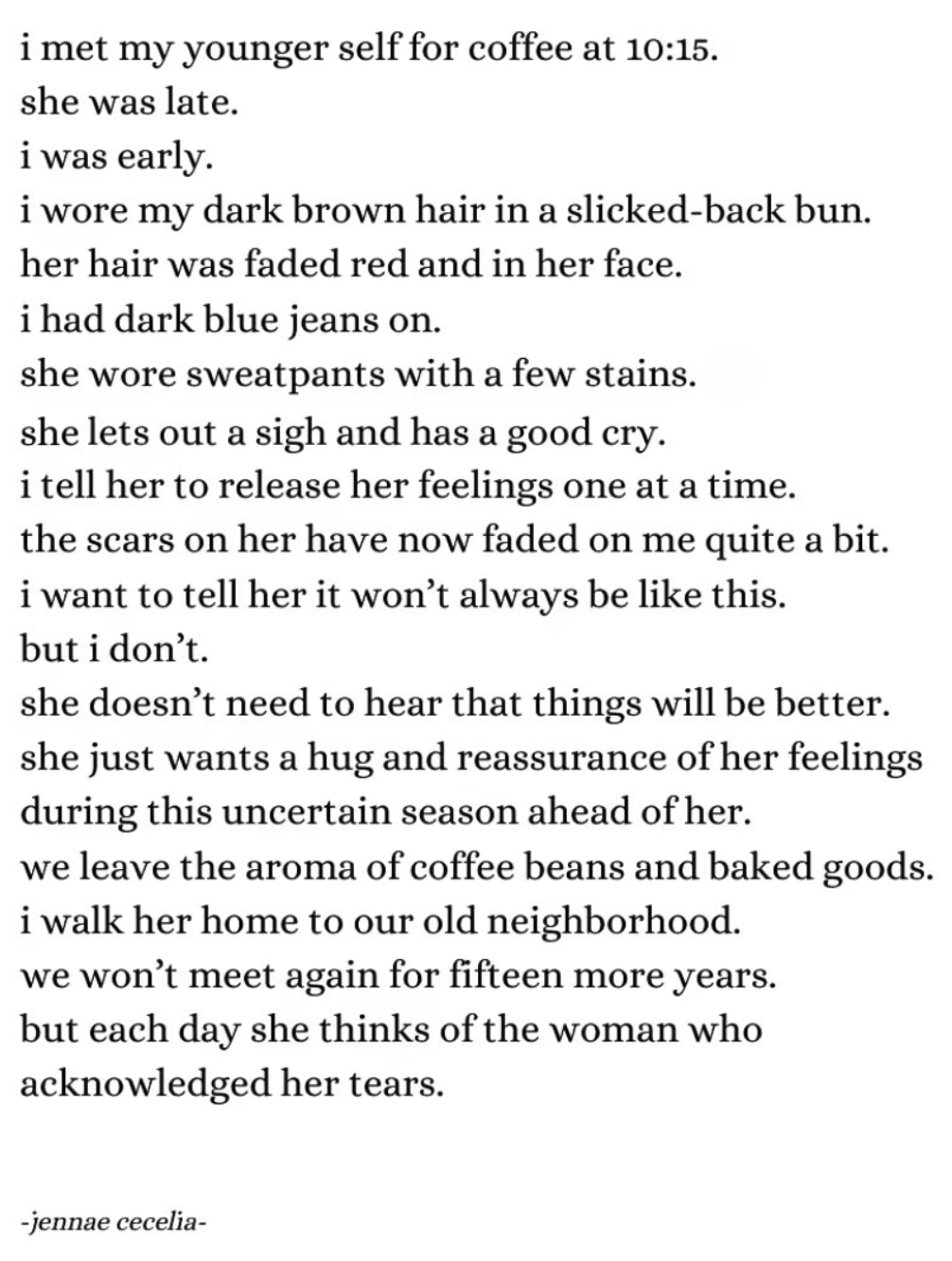
The trend it sparked asks you to do the same: to sit down, across from the version of yourself who was younger and less certain and carrying things you've since put down, and have a conversation with her.
As a coach and behavior change expert who's helped thousands of people change their lives, I've been thinking about why this exercise resonates so deeply with so many people. And I think it's this: it's one of the most compassionate ways to measure how far you've come.
We're not very good at recognizing our own growth in real time. We tend to evaluate ourselves against where we want to be — that gap — rather than against where we started. Which means we're almost always coming up short in our own estimation, even when we've traveled enormous distances to get to where we are right now.
The younger self exercise forces a different comparison. It asks you to look backward instead of forward. And what most people find when they do is something that surprises them: I've come so much further than I realized.
The "I Met My Younger Self For Coffee" Template
Whether you want to write a social media post, a journal entry, a letter to yourself, or just sit quietly and think, here's everything you need to get started.
Step 1: Choose Your Younger Self
Before you begin writing, decide which version of yourself you're inviting to coffee. You might choose:
The version of you at a specific age (10, 16, 22, 30)
The version of you during a specific chapter (college, a difficult relationship, a career transition, early motherhood, a period of loss)
The version of you just before a major change — the person you were right before everything shifted
There's no wrong answer. Go with whoever shows up when you close your eyes and think: she needed someone to talk to.
Step 2: Set the Scene
The details make the exercise real. Before you start writing, answer these grounding questions:
Where are you meeting? (A coffee shop, a kitchen table, a park bench — somewhere that means something)
What is she wearing? What does she look like?
What does she order?
What's her energy when she walks in — nervous, hopeful, exhausted, trying to seem fine?
Step 3: The Writing Prompts
Use as many or as few of these as feel right. You don't have to answer them all — just let yourself be pulled toward the ones that create a little catch in your chest.
About her life then:
What was your younger self most worried about at the time?
What did she think was the most important thing in the world?
What was she carrying that nobody knew about?
What was she hoping for?
What did she believe about herself that wasn't true — or that was true but she didn't know it yet?
What you'd say to her:
What's one thing you'd want her to know that she couldn't possibly know then?
What kindness would you show her that she wasn't always shown?
What would you tell her to stop worrying about?
What would you tell her to pay closer attention to?
Is there anything you'd warn her about — and would you, if you could?
What she'd make of you:
What would she think of who you've become?
What would she be proud of?
What would surprise her most about your life?
Is there anything about who you are now that she'd be confused by — or disappointed in — and how do you feel about that?
The things you wouldn't say:
What's something about how your life turned out that you'd keep to yourself, because the not-knowing was part of the journey?
What's a hard thing she'll go through that you wouldn't take away, even if you could?
The closing of the coffee:
What do you say as you hug goodbye?
What does she carry with her when she walks out?
What do you carry with you?
Step 4: Write It
There's no right format. Some people write a poem in the style of the original. Some write a letter. Some write a scene, like a story. Some just answer the prompts in their journal without worrying about whether it's beautiful.
What makes this exercise powerful isn't the format, it's the honesty.
Why This Is a Coaching Exercise, Not Just a Writing Trend
In the coaching work I do, I don't spend a lot of time in the past. Coaching is fundamentally present and future-focused. We're interested in where you are, where you want to go, and what's in the way. But we do come back to the past for one specific purpose: evidence.
One of the most powerful interventions in behavior change work is helping people see what they've already proven about themselves. Most of us walk around with a very selective memory for our own capability — we catalog our failures and setbacks carefully, and we discount or forget the evidence that we can figure hard things out, that we've navigated things we didn't think we could, that we've changed in ways we once thought were impossible.
The younger self exercise is a way of recovering that evidence.
When you sit down across from the version of you who was twenty-three and heartbroken and not sure how it was going to work out — and you can honestly say it did work out, and here's how — you're doing something genuinely healing for the part of you that is facing whatever feels uncertain right now.
Because the message underneath the exercise is always the same: I've been here before. In a different form, with different stakes. And I found my way through.
Want More Exercises Like This?
If this kind of reflective, behavior-change-meets-real-life content is your thing — I'd love to show up with more in your inbox.
I write a newsletter called The Behavior Edit — it goes out every 10 days and it's the only newsletter I know of that demystifies behavior change and teaches you how to edit your own life. It's filled with honest, relatable, warm, science-backed ideas for building a life you don't need to escape from. Each issue includes the inside scoop on coaching and behavior change, a tool or framework you can actually use, and a powerful question to sit with.
If you want in, sign up here and I'll see you in your inbox 💌📬
Sending love from my little corner of the internet to yours,
🤍 Sonja
I'm Sonja, a board-certified health and wellness coach, behavior change expert, and the creator of the EDIT framework. I help people build lives they don't need to escape from through 1:1 coaching, courses, and a newsletter that demystifies coaching and teaches you how to edit your own behavior.
The Behavior Edit Newsletter
The penpal-like email newsletter that teaches you how to ditch chronic overthinking, perfectionism, imposter syndrome, and procrastination so you can get out of your own way and do the things that matter in life.
Welcome to the safe space for women who know they're way too powerful to be held back by overthinking, perfectionism, imposter syndrome, and procrastination (but need a little help getting out of their own way).
Want to know a secret? These four limited thinking patterns used to be my e-n-t-i-r-e personality. There's a reason I can spot these behaviors from a mile away and help you kick them to the curb.
→ Still replaying that conversation you had at happy hour 2 months ago and wondering if everyone thinks you're weird? Been there.
→ Not finishing the thing you know you want to do because if it's not perfect, then what's the point? Yup.
→ Feeling like it's a matter of time before someone figures out that this is all a carefully crafted facade and that you're actually a fake? Uh-huh.
→ Putting off the things you know you want to do before you die because you're too [insert your adjective of choice] to make it happen now? You betcha.
Sound like I'm reading your mind? That's cause these were the thoughts, beliefs, and behaviors that ran my life for wayyy too long.
There's nothing I love more than helping badass women kick this shit to the curb so they can get out of their own way and do the things that matter in life - Here's how I can help you make it happen
The Behavior Edit
(for people who want to make a change)
Most of my clients show up here when they get tired of carrying the weight of an unfinished project and the grief of an unrealized dream.
I'm here to help you finish the one meaningful thing you don't want to leave undone in life — and prove to yourself that you're not too late, you're not broken, and you're more capable than you think.
The Business Edit
(for coaches in private practice)
Here's the thing they don't tell you in your coach training program:
Being a great coach and running a successful coaching practice are two completely different skills.
If you're ready to trade uncertainty for strategy and stress for execution, The Business Edit is for you.
The Study Edit
(for future NBC-HWCs)
Take the guesswork out of studying for the NBHWC Board Exam. My course, The Study Edit, has helped 253 students learn how to think like an exam writer and earn their NBC-HWC credential.
Here, you get everything you need to pass this test, all in one place, backed by my money-back guarantee.