How to Pass Your NBHWC Board Exam
- Sonja Ecklund, NBC-HWC
What the exam actually tests, why most coaches study the wrong way, and how to walk in prepared
I sat for the NBHWC board exam in September 2017 — in the very first cohort on the very first day the exam was ever offered. Before there were study guides, prep courses, or anyone who had done it before to ask.
I'm an extremely nervous and anxious test taker, and thankfully, I passed. But I also learned a lot about what the exam actually tests, what kind of preparation actually works, and how the questions are structured. In the years since, I've helped over 200 coaches pass this exam. What I've seen repeatedly is that when coaches don't pass on their first try, it's because their systems for studying and preparing for the exam fell short.
This post is my attempt to fix that.
What the NBHWC Board Exam is
The NBHWC Board Exam is the national credentialing exam for health and wellness coaches. Passing it earns you the NBC-HWC designation — the highest credentialing standard in the field at this time, and one that is increasingly required by employers, health systems, and digital health companies.
To sit for the exam, you need to have completed an NBHWC-approved training program and completed a minimum of 50 coaching sessions. Once you're eligible, you register through the NBME (National Board of Medical Examiners) and schedule your exam at a Prometric testing center.
The exam itself is a 150-question, multiple choice exam with 5 answer choices per question (A, B, C, D, E). You have four hours to complete the exam, including a tutorial at the beginning, section 1 (75 questions), a 15-minute break, section 2 (75 questions), and a survey at the end.
The most important thing to understand about this exam
Here's the thing that changes everything about how you prepare: The NBHWC board exam is testing your knowledge recall of coaching and health concepts and it's testing your ability to apply that knowledge to specific coaching scenarios.
Most questions on the exam present real coaching scenarios — a client says something, a situation unfolds, a decision has to be made — and asks you what a skilled, ethical, coach practicing within their scope of practice would do in that moment.
This means that studying by reading through your training materials and trying to memorize a bunch of content is not an effective study strategy. You can know every behavior change theory perfectly and still get tripped up by the scenario questions if you haven't practiced thinking in that format.
The preparation that actually works is scenario-based. You need to practice reading questions that are written in the same way the exam writes them, identifying what's actually being asked, and selecting the answer that reflects the coaching best practices.
To make it even more challenging, the NBHWC Board Exam often presents more than one correct answer within the answer bank. That means your job is to choose the best answer available to you.
What the exam covers
The NBHWC exam tests you on all five content areas from the NBHWC Content Outline. Here's the overview of all 5 sections:
1. Coaching Presence, Relationships, and Sessions (25%). How you open and close sessions, establish coaching agreements, manage initial and follow up conversations, and navigate the arc of the coaching relationship over time.
2. Theories, Models, and Approaches to Behavior Change (15%). This is a substantial portion of the exam. Motivational interviewing, The Transtheoretical Model (Stages of Change), Goal Setting Approaches, Neuroplasticity, Self-Efficacy theories (Social Cognitive Theory, Social Learning Theory), Self-Determination Theory, Positive Psychology, and Appreciative Inquiry are all fair game.
3. Skills, Tools, and Strategies (25%). This section is all about applying skills in active listening, empathy, and communication, with the goal of establishing rapport, building trust, and fostering a supportive coaching relationship. Knowing how, when, and why to apply techniques like motivational interviewing, goal setting, and behavior change to empower a client is key. This section also covers cultural humility, inclusivity, and equity.
4. Ethics and Professional Practice (15%). Professional standards, HIPAA, documentation, cultural humility and sensitivity, confidentiality, dual certifications, AI, and when to make a referral are all covered in this section.
5. Health and Wellness (20%). The evidence base for nutrition, physical activity, sleep, stress management, and related areas. This also includes memorizing the biometric ranges for lifestyle conditions and diseases. This section is broader than it is deep — you need familiarity with the major findings and guidelines, not clinical expertise.
Why coaches fail this exam
In my experience helping coaches prepare for this exam, the most common reasons students don't pass are:
Studying too broadly. Trying to learn everything about everything — reading every book, watching every video, reviewing every topic from training — spreads your preparation too thin. The exam tests specific competencies in specific ways. Studying the NBHWC Content Outline strategically is more effective than studying every single resource you can find.
Not practicing with scenario-based questions. The format of the exam questions is specific, and understanding how to read the questions and think like an exam writer takes practice. Coaches who sit down to study by reviewing notes but never practice actually answering exam-style questions are not preparing for the right thing.
Memorizing concepts instead of applying them. It's not enough to memorize concepts like Motivational Interviewing, OARS, Appreciative Inquiry, The Self-Determination Theory, etc. You have to actually know how to apply them in a real coaching setting. If you're not sure what concept to choose when and how to apply it, that would be a good place to start.
Not reading the NBHWC Content Outline. The NBHWC Content Outline tells you exactly what content will be on the exam. It's the most useful study document available, and a surprising number of students never read it. Or, they briefly skim it and then forget about it entirely. Successful students base their entire study plan on this document.
What actually works
Download The NBHWC Content Outline. Read it thoroughly. This is your exam blueprint. If you don't understand a concept inside of it, then you know where to put your focus while you study!
Build a strong foundation in listening skills. Know the details of MI, AI, TTM, And know what each of these looks like in practice, not just in theory.
Know the Stages of Change inside and out. Not just the names of the stages, but what coaching looks like in each one. What does a client in contemplation need that's different from a client in preparation? How do you adjust your approach based on where someone is in the change process?
Practice with scenario-based questions. This is non-negotiable. Sit down regularly with exam-style questions, practice selecting answers, and review why the correct answer is correct and why the others aren't. The reasoning matters as much as the answer.
Don't skip the ethics and scope section. Scope-of-practice questions are specific and sometimes tricky. Know where the coaching lane is. Know what requires a referral. Know the professional standards you're held to as an NBC-HWC.
Give yourself a realistic study timeline. Most coaches need four to eight weeks of focused, intentional preparation. A week of cramming is not enough. A month of casual reviewing is also not enough. Set a schedule, treat it like a commitment, and follow through.
The resource I built for this
When I couldn't find a preparation resource that did all of this and more, I built one.
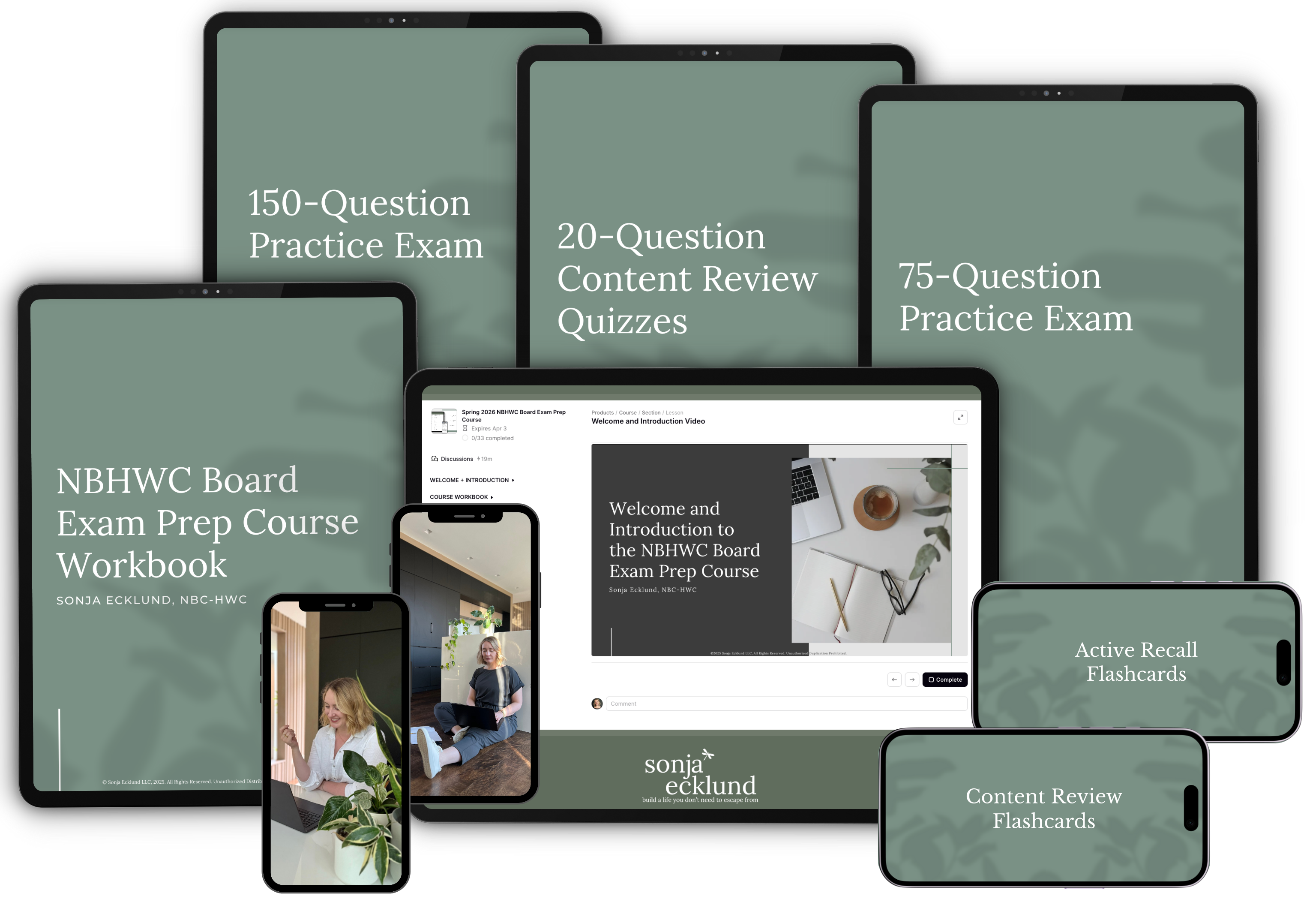
The Study Edit is my NBHWC board exam prep course — a comprehensive, structured course that walks you through everything you need to know to pass this exam.
It covers the content you need to know, teaches you how to read and approach the exam's questions, and prepares you to walk into your exam feeling calm, confident, and prepared. It comes with 400 practice questions, 328 flashcards, optional live group study sessions in the month leading up to the exam, all of your study materials all in one place, a course workbook to help you organize everything, and videos on test taking tips and tricks, building a study plan, and preparing for exam day.
And it's backed by a full money-back guarantee: If you complete the course and don't pass your exam, I'll give you your money back. Read the FAQ section for the full scoop on what you need to do to opt in to the money back guarantee.
Just looking for practice exam questions?
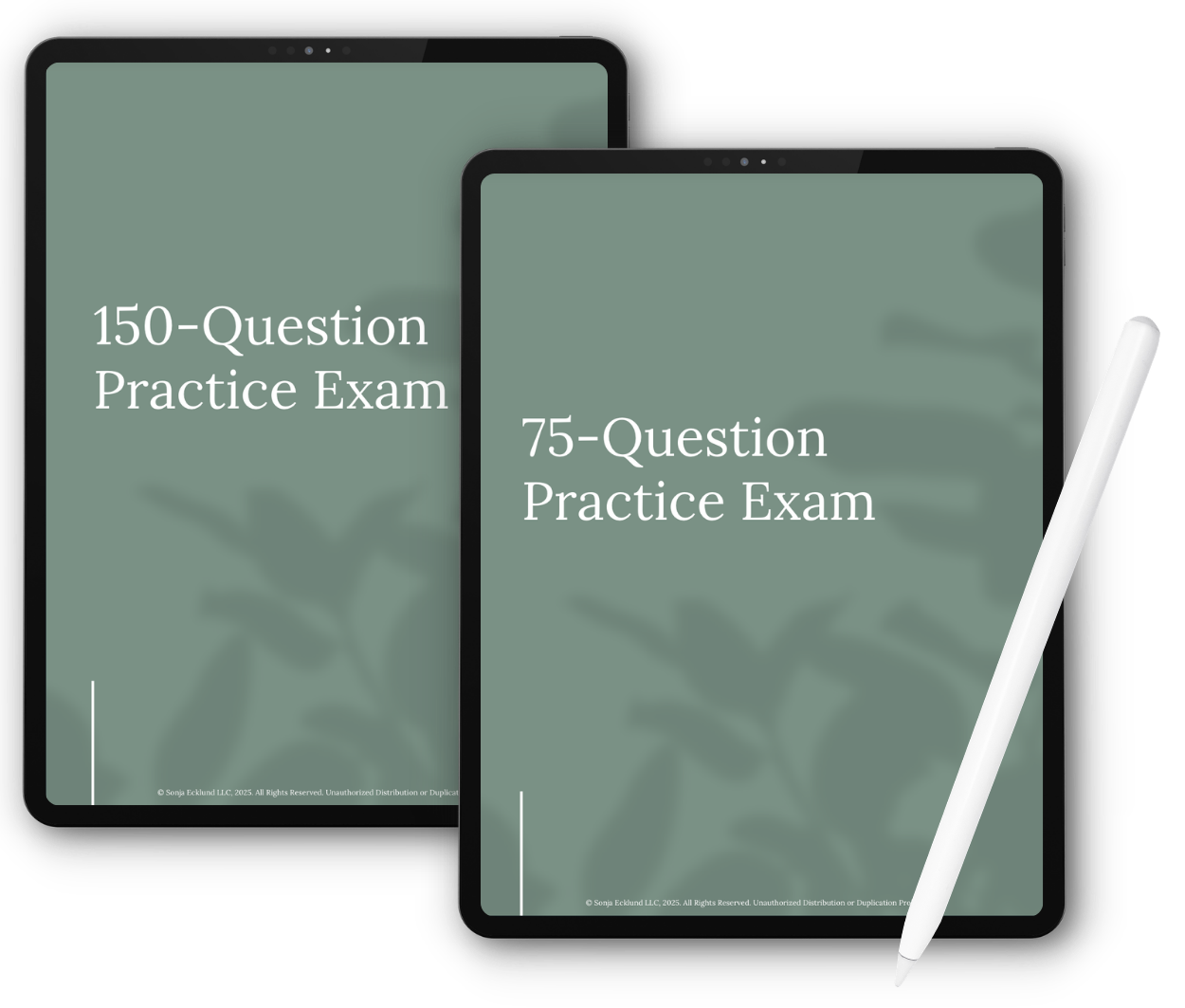
If you don't need a full prep course but you want to purchase a high quality practice exam, check out my practice exam bundle.
It gives you a full-length 150-question practice exam, a half-length 75-question practice exam, and a 25-question quiz on preparing for exam day.
Still thinking about what you need?
Check out my webinar replay, How to Pass Your NBHWC Board Exam for additional study strategies and tips.
A Final Note
The NBHWC board exam is rigorous. It's designed to be. It's the thing that distinguishes board-certified health coaches from the thousands of people who call themselves health coaches without any meaningful credential behind it. Passing it matters, both for the profession and for you your career progression.
You've put in the work to get here. The training hours, the coaching sessions, the commitment to this field. The exam is the last step between you and the credential that officially tells the world that you're as skilled as you know yourself to be.
Study strategically and you'll walk into exam day knowing that you passed. Good luck!
The Behavior Edit Newsletter
The penpal-like email newsletter that teaches you how to ditch chronic overthinking, perfectionism, imposter syndrome, and procrastination so you can get out of your own way and do the things that matter in life.
Welcome to the safe space for women who know they're way too powerful to be held back by overthinking, perfectionism, imposter syndrome, and procrastination (but need a little help getting out of their own way).
Want to know a secret? These four limited thinking patterns used to be my e-n-t-i-r-e personality. There's a reason I can spot these behaviors from a mile away and help you kick them to the curb.
→ Still replaying that conversation you had at happy hour 2 months ago and wondering if everyone thinks you're weird? Been there.
→ Not finishing the thing you know you want to do because if it's not perfect, then what's the point? Yup.
→ Feeling like it's a matter of time before someone figures out that this is all a carefully crafted facade and that you're actually a fake? Uh-huh.
→ Putting off the things you know you want to do before you die because you're too [insert your adjective of choice] to make it happen now? You betcha.
Sound like I'm reading your mind? That's cause these were the thoughts, beliefs, and behaviors that ran my life for wayyy too long.
There's nothing I love more than helping badass women kick this shit to the curb so they can get out of their own way and do the things that matter in life - Here's how I can help you make it happen
The Behavior Edit
(for people who want to make a change)
Most of my clients show up here when they get tired of carrying the weight of an unfinished project and the grief of an unrealized dream.
I'm here to help you finish the one meaningful thing you don't want to leave undone in life — and prove to yourself that you're not too late, you're not broken, and you're more capable than you think.
The Business Edit
(for coaches in private practice)
Here's the thing they don't tell you in your coach training program:
Being a great coach and running a successful coaching practice are two completely different skills.
If you're ready to trade uncertainty for strategy and stress for execution, The Business Edit is for you.
The Study Edit
(for future NBC-HWCs)
Take the guesswork out of studying for the NBHWC Board Exam. My course, The Study Edit, has helped 253 students learn how to think like an exam writer and earn their NBC-HWC credential.
Here, you get everything you need to pass this test, all in one place, backed by my money-back guarantee.